My video poem "susurrations" was featured on Street Anatomy last week. Street Anatomy is one of my favourite blogs. Its curator, Vanessa Ruiz is "obsessed with the beauty and intrigue of human anatomy" as am I.
susurrations from Lia Pas on Vimeo.
The video is about 10 minutes long.
Monday, January 28, 2013


Thursday, January 24, 2013
Transforium
The reading, unfolding, launching of “Transforium” by Tammy Lu and Mari-Lou Rowley (JackPine Press 2012). Thanks to Lia Pas for helping us decipher the poem-map.
Transforium Unfolded from Tammy Lu on Vimeo.
Transforium Unfolded from Tammy Lu on Vimeo.
Crackers still Crisp
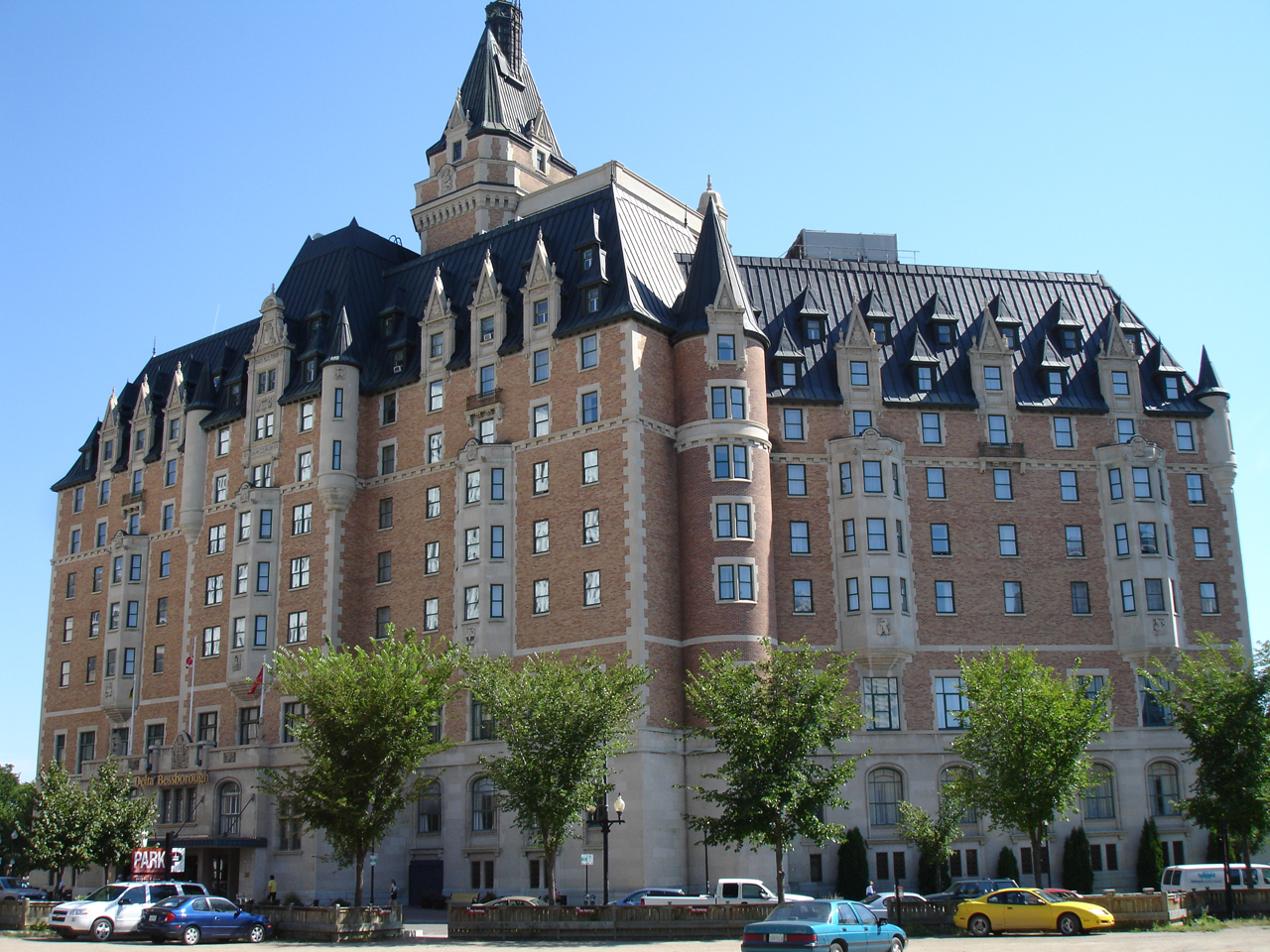
Yes, the crackers are back, revived and crisp and salty as ever.. Today we met at the Bessborough hotel lounge and had a nice little table beside a business man who bought our first round in exchange for watching his computer while he went for a smoke. It was minus 25 today so he wasn't gone long.
Speaking of exchange, some great show and tell, all with metaphysical/neo-surrealist themes..
From Hilary, two new books of poetry
Looms, by Camille Martin
Gravesend, by Cole Swensen
From Fioncara (via Yvette Nolan)
The Saint Plays, by Erik Ehn
From Lia
The Mystic in the Theatre --Elenora Duse, by Eva Le Gallienne
From Mari-Lou (via Matthew Hall)
tarpaulin sky by Juliana Spahr
Friday, March 26, 2010
Ashtavakra Gita
This week I began composing a choral arrangement of Chapter VI of the Ashtavakra Gita.
The arrangement will be sung in the original Sanskrit, but here is my re-writing of John Fisher's translation:
I am space. unbounded.
While the world is like a jar.
I know this as knowledge.
I do not deny this.
I do not accept this.
I do not stop this.
I am the ocean.
While the abundance of matter is like a wave.
I know this as knowledge.
I do not deny this.
I do not accept this.
I do not stop this.
I am mother-of-pearl.
While the envisioned world is like iridescence.
I know this as knowledge.
I do not deny this.
I do not accept this.
I do not stop this.
Again.
I am in all.
While all is in me.
I know this as knowledge.
I do not deny this.
I do not accept this.
I do not stop this.
Friday, March 19, 2010
Another needy poem
The Way We Need (for Paul)
i can't explain
the i
you
need to
the way you need
the way i feel
need to,
the needing way you feel
the need
i can't explain
the feeling i need,
your need to feel
i can't explain.
an old "needy" poem from a knife a rope a book (Underwhich Editions 1990)
i can't explain
the i
you
need to
the way you need
the way i feel
need to,
the needing way you feel
the need
i can't explain
the feeling i need,
your need to feel
i can't explain.
an old "needy" poem from a knife a rope a book (Underwhich Editions 1990)
when need comes near
Finished a piece for voice & piano started in 2007: when need comes near
when need comes near
I walk
away
when need comes near
I wait
in the open doorway
wait
to walk
away
waiting for a way
to be
away
when need comes near
I walk
I wait
I walk
away
Sunday, March 14, 2010
Feral Verses
Sunday posting from Mari-Lou
From the back of the car Cicero thought he heard donkeys braying.
Hit me again and I’ll prorogue parliament the lawyer’s son said to the bully.
Once you study law you see the whole world differently.
I am a poet. I dream of aquatic plants sprouting from my leg.
Calf to be exact, right calf muscle where the Achilles tendon left off.
Achilles wasn’t afraid of anything, except hurting his heel. Thus he didn’t dance or wear flat sandals.
Tantrum prone, unlike Cicero who just couldn’t hold his tongue. Unlike the lawyer’s son who couldn’t tongue his hold.
From the back of the car Cicero thought he heard donkeys braying.
Hit me again and I’ll prorogue parliament the lawyer’s son said to the bully.
Once you study law you see the whole world differently.
I am a poet. I dream of aquatic plants sprouting from my leg.
Calf to be exact, right calf muscle where the Achilles tendon left off.
Achilles wasn’t afraid of anything, except hurting his heel. Thus he didn’t dance or wear flat sandals.
Tantrum prone, unlike Cicero who just couldn’t hold his tongue. Unlike the lawyer’s son who couldn’t tongue his hold.
Saturday, March 13, 2010
spring crackers
Much ado about much at Rembrandt's yesterday. Hello to all who showed, told and processed poetry-related news, books, ephemera. Lia: wonderful suggestions all:
Steve Tomasula, "The Sensualist", "Mark Danielewski's "House of Leaves". And thanks for suggesting Twyla Tharp's "The creative Habit"
Check out Ugly Duckling Press. Great writing and design with the word in mind.
Lia, It would be great to hear more about the Banff conference here...
Remember post your work! or that you worked.. here by midnight Sunday!
Get crunching.
Steve Tomasula, "The Sensualist", "Mark Danielewski's "House of Leaves". And thanks for suggesting Twyla Tharp's "The creative Habit"
Check out Ugly Duckling Press. Great writing and design with the word in mind.
Lia, It would be great to hear more about the Banff conference here...
Remember post your work! or that you worked.. here by midnight Sunday!
Get crunching.
Friday, July 10, 2009
really strange writing exercises
http://somaticpoetryexercises.blogspot.com/
The exercise descriptions are almost poems themselves.
The exercise descriptions are almost poems themselves.
Tuesday, June 23, 2009
Gerry Gilbert 1936-2009
 http://www.theeastvillage.com/tc/gilbert/a.htm
He was a sweet guy. He'd be at every poetry reading at the Kootenay School and elsewhere, taping for his poetry show on Vancouver Co-op Radio. Always absolutely present.
"We'll always be here."
Thursday, June 4, 2009
David Bromige
David Bromige died yesterday June 3. He was at the 1995 conference in Vancouver in honour of Robin Blaser, who also died recently. Bromige's paper can be found in the book The Recovery of the Public World: it's entitled "The Poetics of the Vulnerable." A few sentences:
"Vulnerability is a desired quality in poetry as in life more generally. . . . That which is vulnerable has room for us in it, as it has room for the new. We well may disagree with it . . . but we will be able to do so from within the work. It will be not-teflon."
A number of poems by Bromige, selected by Meredith Quartermain, can be found in Golden Handcuffs Review 10:
http://www.goldenhandcuffsreview.com/gh10content/8.html
On the East Village Poetry Web, there's a link to Bromige's poem "Fall," which is his translation of Rilke's "Autumn" into "Californian" English. First Rilke's poem (English trans. Stephen Mitchell):
Next The East Village Poetry
"Vulnerability is a desired quality in poetry as in life more generally. . . . That which is vulnerable has room for us in it, as it has room for the new. We well may disagree with it . . . but we will be able to do so from within the work. It will be not-teflon."
A number of poems by Bromige, selected by Meredith Quartermain, can be found in Golden Handcuffs Review 10:
http://www.goldenhandcuffsreview.com/gh10content/8.html
On the East Village Poetry Web, there's a link to Bromige's poem "Fall," which is his translation of Rilke's "Autumn" into "Californian" English. First Rilke's poem (English trans. Stephen Mitchell):
AutumnFall
Lord: it is time. The huge summer has gone by.
Now overlap the sundials with your shadows,
and on the meadows let the wind go free.
Command the fruits to swell on tree and vine;
grant them a few more warm transparent days,
urge them on to fulfillment then, and press
the final sweetness into the heavy wine.
Whoever has no house now, will never have one.
Whoever is alone will stay alone,
will sit, read, write long letters through the evening,
and wander along the boulevards, up and down,
restlessly, while the dry leaves are blowing.
Now Bromige:
(Rilke into Californian)

      Man, where'd the time go? Detroit?.
      But summer was really, really great.

      Stand that side of the sundial, will ya?
      I want to dig the shadows.

      Robert Duncan's freaking in the meadow.

      Those apples can't get a whole lot riper.
      Give em a couple more hot days.
      My friends who have the winery are already making the wine.

      It's getting chilly, nights. If you don't have a pad by now,
      Too bad. If you're not seeing someone
      You're likely stuck that way, they went back to school.

      Crack a book yourself. Write in Starbucks.
      Go walkabout downtown. [Time passes]. Hey, lookit
      the leaves, wind, etc. doing their thing. Rustle rustle.
      Contrast and compare yourself. Cool!
Next The East Village Poetry
Sunday, May 31, 2009
publication by Sylvia Legris
Here's Sylvia in good company; she's in issue #26 as well. Laynie Brown is one of my favorites.
NEW AMERICAN WRITING #27 with work from Mahmoud Darwish on Edward Said, Ben Lerner on Barbara Guest, Etel Adnan, SYLVIA LEGRIS, Phillip Foss, Clayton Eshleman, Ray Ragosta, Caroline Knox, Laynie Brown, Jennifer Pilch, Ales Steger, Brian Henry GC Waldrep, Brandon Shimoda, John Olson, Leonard Schwartz, Gassan Zaqtan, Fady Joudah, Rachel Loden, Sharon Dolin, Edward Smallfield, Joshua Kryah, Amy Pence, Linh Dinh, and many others.
NEW AMERICAN WRITING #27 with work from Mahmoud Darwish on Edward Said, Ben Lerner on Barbara Guest, Etel Adnan, SYLVIA LEGRIS, Phillip Foss, Clayton Eshleman, Ray Ragosta, Caroline Knox, Laynie Brown, Jennifer Pilch, Ales Steger, Brian Henry GC Waldrep, Brandon Shimoda, John Olson, Leonard Schwartz, Gassan Zaqtan, Fady Joudah, Rachel Loden, Sharon Dolin, Edward Smallfield, Joshua Kryah, Amy Pence, Linh Dinh, and many others.
Thursday, May 21, 2009
experiments
Charles Bernstein's list of generative experiments is at
http://www.writing.upenn.edu/bernstein/experiments.html
http://www.writing.upenn.edu/bernstein/experiments.html
Tuesday, May 5, 2009
Two new titles of interest
From Book Thug's monthly e-list:

Emerson, Lori [ed]. OPEN LETTER 13:8 (2009): bpNichol + 21. 2009. Contributions include: a seeing of your writing: An Introduction. LORI EMERSON; Openings: bpNichol's Ephemera by KIT DOBSON; Anxieties, Orthodoxies, and Histories in (the 1990's Critical Reception of) bpNichol's The Martyrology by CLINT BURNHAM; Hopelessly Devoted: The Sacred and the Sloppy in bpNichol Criticism by STEPHEN CAIN; The Unquiet Poem: bpNichol's Re-Sounding Cultural Geographies by LEIF EINARSON; Generations Generated by STEPHEN SCOBIE; Apocalypse Now: The Four Horsemen Burn Through Atlanta by JAMES SANDERS and MARK PREJSNAR; The Practice of Community: bpNichol and Steve McCaffery in Collaboration by STEPHEN VOYCE; bp Anecdotingly by PAUL DUTTON; Blurring the Borders/Bordering the Blurs: bpNichol and derek beaulieu by JONATHAN BALL; Conceptual Writing and bpNichol by DEREK BEAULIEU; Men Write What Men Mean: The "Pataphysics of bpNichol's Zygal by STEVEN ZULTANSKI; vol a vent by NATALIE ZINA WALSCHOTS; b & P in bpNichol Lane: A Look by MARIE BUCK; city bp, everywhere by BRAD FLIS; Modern Fiction and The Decay of History: bpNichol's The True Eventual Story of Billy the Kid by CARL PETERS.
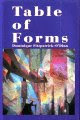
FITZPATRICK-O'DINN, Dominique. Table of Forms. Urbana: Spineless Books, 2006. Bridging the sonnet and palindrome through a rich taxonomy of new literary forms, Table of Forms is a collection of experimental, ludic, constraint-driven poetry; a puzzle book; and a writing manual. Dominique Fitzpatrick-O'Dinn and her skilled team of collaborators have created the most comprehensive survey of noncanonical poetic techniques since the Oulipo Compendium. Offering myriad reading paths, this multisequential anthology includes a Table of Contents, Table of Forms, Glossary of Forms, and a matrix on the back cover.
Tuesday, April 14, 2009
Writing sonnets, cont.

 Another installment in (hopefully) a series featuring ways the sonnet can be written:
Here is a sonnet from British poet Geraldine Monk's Ghost and Other Sonnets (Salt Publishing, 2008). Nice sounds:
Chronic webbings. Intrigue.
Androgynous flush haunts
Reptilian spine vault gothic.
Vehement throb conflicts on
Polyphonic gutwire. Phantom strings
Berserk minor arpeggios. Buttress ups
Super star dome. Sanctuary out to lunch.
Alone and pale and sort of floaty
Fingers clutched the altar rails of dread
Draining the face with featureless
Caress a shaft of light carved through her
Strained glass prelude.
Fragmented fugues of spheres break
Wind on mobile ring tones. Discarnate.
Friday, April 3, 2009
Writing sonnets
A link to a talk by Ted Berrigan on writing sonnets (from the Poetry Project Papers, 1989):
http://poetryproject.org/wp-content/uploads/v2-ted-berrigan.pdf


Here is one of his sonnets from The Sonnets:
http://poetryproject.org/wp-content/uploads/v2-ted-berrigan.pdf

Here is one of his sonnets from The Sonnets:
Dear Margie, hello. It is 5:15 a.m.
dear Berrigan. He died
Back to books. I read
It's 8:30 p.m. in New York and I've been running around all day
old come-all-ye's streel into the streets. Yes, it is now,
How Much Longer Shall I Be Able To Inhabit The Divine
and the day is bright gray turning green
feminine marvelous and tough
watching the sun come up over the Navy Yard
to write scotch-tape body in a notebook
had 17 and 1/2 milligrams
Dear Margie, hello. It is 5:15 a.m.
fucked til 7 now she's late to work and I'm
18 so why are my hands shaking I should know better
Friday, March 20, 2009
Rae Armantrout's poetics
We wake up to an empty room
addressing itself in scare quotes.
(Rae Armantrout, from "Reversible")
The following are some interesting comments Charles Bernstein made in introducing Rae Armantrout at a recent reading; they touch on not only Armantrout's poetics but disjunctive or associative poetics in general. The comments are posted on his blog: http://epc.buffalo.edu/
authors/bernstein/blog/#03-17-09/
"Armantrout’s work is not surrealism, not realism, but para- or peri-realism: it is constructed of precisely articulated observations that seem to logically follow one another but that, like everyday life, don’t or better to say, don’t quite. Her rhythms are of dislocation and relocation. Armantrout’s signature is serial displacement: incommensurability torques from one iteration to another, like Marcel Marceau miming a mime miming. Such an approach can be used for many ends. Armantrout’s engagement is often social and cultural dysfunction, giving her work its dark undertones and muted overtones. In this way, she depicts the socio-cultural logic of late Capitalism; dark matter, indeed. So yeah, sure, please be sure to note: her work enacts, through its multifoliate insights, an ideological critique, as when you lose your balance but don’t fall; you realize something must be wrong but don’t know what. Preston Sturges said it best: if you can’t sleep at night, it’s not the coffee it’s the bunk.
So, yes, Armantrout is one of the grand masters of our beloved radical disjunction of the 1970s and 80s. If one were to chart the vectors of each of her lines, you would get a field of skewed angles. Her motto might be: One perception must lead tangentially to the next. But tangential is not arbitrary or disconnected. Tangential is the mark of contingency but also motivated relation. To follow associative and peripheral connections – non-rationalizable, nonexpository, non-narrative – offers a constantly reiterated possibility of new perceptions.
Next to us is not the world we know so well, which we use to do our bidding, but the world that could be, the world we might make. I jump the line because I am so tired of waiting in it. . . ."
Let's jump the line and into that space of tangential perception, between one line and the next.
addressing itself in scare quotes.
(Rae Armantrout, from "Reversible")
The following are some interesting comments Charles Bernstein made in introducing Rae Armantrout at a recent reading; they touch on not only Armantrout's poetics but disjunctive or associative poetics in general. The comments are posted on his blog: http://epc.buffalo.edu/
authors/bernstein/blog/#03-17-09/
"Armantrout’s work is not surrealism, not realism, but para- or peri-realism: it is constructed of precisely articulated observations that seem to logically follow one another but that, like everyday life, don’t or better to say, don’t quite. Her rhythms are of dislocation and relocation. Armantrout’s signature is serial displacement: incommensurability torques from one iteration to another, like Marcel Marceau miming a mime miming. Such an approach can be used for many ends. Armantrout’s engagement is often social and cultural dysfunction, giving her work its dark undertones and muted overtones. In this way, she depicts the socio-cultural logic of late Capitalism; dark matter, indeed. So yeah, sure, please be sure to note: her work enacts, through its multifoliate insights, an ideological critique, as when you lose your balance but don’t fall; you realize something must be wrong but don’t know what. Preston Sturges said it best: if you can’t sleep at night, it’s not the coffee it’s the bunk.
So, yes, Armantrout is one of the grand masters of our beloved radical disjunction of the 1970s and 80s. If one were to chart the vectors of each of her lines, you would get a field of skewed angles. Her motto might be: One perception must lead tangentially to the next. But tangential is not arbitrary or disconnected. Tangential is the mark of contingency but also motivated relation. To follow associative and peripheral connections – non-rationalizable, nonexpository, non-narrative – offers a constantly reiterated possibility of new perceptions.
Next to us is not the world we know so well, which we use to do our bidding, but the world that could be, the world we might make. I jump the line because I am so tired of waiting in it. . . ."
Let's jump the line and into that space of tangential perception, between one line and the next.
Thursday, February 26, 2009
Anagrams
Interesting (but probably very slow) technique. See method in Author's Note below. Results at:
http://www.unf.edu/mudlark/mudlark30/contents.html
http://www.unf.edu/mudlark/mudlark30/contents.html
Author’s Note. Each of the poems in Anagrams of America is an anagram of its source text. All of the letters of the source text have been used, once and only once, in the composition of the corresponding poem. No letters have been added and no letters have been left out. Many of the sources are familiar works by familiar authors, and I have indicated below each poem the text used. Unless otherwise indicated, titles, epigraphs, section numbers, and section headings are not to be considered part of the anagram. — Mike Smith
Wednesday, February 18, 2009
MESHWORKS (Miami University Archive of Writing in Performance)


Bill Griffiths
This site has a great list of mp3's of poets reading: Bill Griffiths, Fanny Howe, Rae Armantrout, SoundEye (Irish sound poetry conference), Contemporary Experimental Women's Poetry Festival, and more.
http://www.orgs.muohio.edu/meshworks/index.html
Thursday, January 29, 2009
Managable Imaginations
Hello all, check out the interview re: Suicide Psalms on Tracy Hamon's blog.
http://thamon.wordpress.com/2009/01/27/interview-with-mari-lou-rowley
Hilary, thanks for the google exercise. still haven't had time to try.
Keep warm. ML
http://thamon.wordpress.com/2009/01/27/interview-with-mari-lou-rowley
Hilary, thanks for the google exercise. still haven't had time to try.
Keep warm. ML
Subscribe to:
Posts (Atom)