Here's Sylvia in good company; she's in issue #26 as well. Laynie Brown is one of my favorites.
NEW AMERICAN WRITING #27 with work from Mahmoud Darwish on Edward Said, Ben Lerner on Barbara Guest, Etel Adnan, SYLVIA LEGRIS, Phillip Foss, Clayton Eshleman, Ray Ragosta, Caroline Knox, Laynie Brown, Jennifer Pilch, Ales Steger, Brian Henry GC Waldrep, Brandon Shimoda, John Olson, Leonard Schwartz, Gassan Zaqtan, Fady Joudah, Rachel Loden, Sharon Dolin, Edward Smallfield, Joshua Kryah, Amy Pence, Linh Dinh, and many others.
Sunday, May 31, 2009


Thursday, May 21, 2009
experiments
Charles Bernstein's list of generative experiments is at
http://www.writing.upenn.edu/bernstein/experiments.html
http://www.writing.upenn.edu/bernstein/experiments.html
Tuesday, May 5, 2009
Two new titles of interest
From Book Thug's monthly e-list:

Emerson, Lori [ed]. OPEN LETTER 13:8 (2009): bpNichol + 21. 2009. Contributions include: a seeing of your writing: An Introduction. LORI EMERSON; Openings: bpNichol's Ephemera by KIT DOBSON; Anxieties, Orthodoxies, and Histories in (the 1990's Critical Reception of) bpNichol's The Martyrology by CLINT BURNHAM; Hopelessly Devoted: The Sacred and the Sloppy in bpNichol Criticism by STEPHEN CAIN; The Unquiet Poem: bpNichol's Re-Sounding Cultural Geographies by LEIF EINARSON; Generations Generated by STEPHEN SCOBIE; Apocalypse Now: The Four Horsemen Burn Through Atlanta by JAMES SANDERS and MARK PREJSNAR; The Practice of Community: bpNichol and Steve McCaffery in Collaboration by STEPHEN VOYCE; bp Anecdotingly by PAUL DUTTON; Blurring the Borders/Bordering the Blurs: bpNichol and derek beaulieu by JONATHAN BALL; Conceptual Writing and bpNichol by DEREK BEAULIEU; Men Write What Men Mean: The "Pataphysics of bpNichol's Zygal by STEVEN ZULTANSKI; vol a vent by NATALIE ZINA WALSCHOTS; b & P in bpNichol Lane: A Look by MARIE BUCK; city bp, everywhere by BRAD FLIS; Modern Fiction and The Decay of History: bpNichol's The True Eventual Story of Billy the Kid by CARL PETERS.
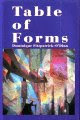
FITZPATRICK-O'DINN, Dominique. Table of Forms. Urbana: Spineless Books, 2006. Bridging the sonnet and palindrome through a rich taxonomy of new literary forms, Table of Forms is a collection of experimental, ludic, constraint-driven poetry; a puzzle book; and a writing manual. Dominique Fitzpatrick-O'Dinn and her skilled team of collaborators have created the most comprehensive survey of noncanonical poetic techniques since the Oulipo Compendium. Offering myriad reading paths, this multisequential anthology includes a Table of Contents, Table of Forms, Glossary of Forms, and a matrix on the back cover.
Tuesday, April 14, 2009
Writing sonnets, cont.

 Another installment in (hopefully) a series featuring ways the sonnet can be written:
Here is a sonnet from British poet Geraldine Monk's Ghost and Other Sonnets (Salt Publishing, 2008). Nice sounds:
Chronic webbings. Intrigue.
Androgynous flush haunts
Reptilian spine vault gothic.
Vehement throb conflicts on
Polyphonic gutwire. Phantom strings
Berserk minor arpeggios. Buttress ups
Super star dome. Sanctuary out to lunch.
Alone and pale and sort of floaty
Fingers clutched the altar rails of dread
Draining the face with featureless
Caress a shaft of light carved through her
Strained glass prelude.
Fragmented fugues of spheres break
Wind on mobile ring tones. Discarnate.
Friday, April 3, 2009
Writing sonnets
A link to a talk by Ted Berrigan on writing sonnets (from the Poetry Project Papers, 1989):
http://poetryproject.org/wp-content/uploads/v2-ted-berrigan.pdf


Here is one of his sonnets from The Sonnets:
http://poetryproject.org/wp-content/uploads/v2-ted-berrigan.pdf

Here is one of his sonnets from The Sonnets:
Dear Margie, hello. It is 5:15 a.m.
dear Berrigan. He died
Back to books. I read
It's 8:30 p.m. in New York and I've been running around all day
old come-all-ye's streel into the streets. Yes, it is now,
How Much Longer Shall I Be Able To Inhabit The Divine
and the day is bright gray turning green
feminine marvelous and tough
watching the sun come up over the Navy Yard
to write scotch-tape body in a notebook
had 17 and 1/2 milligrams
Dear Margie, hello. It is 5:15 a.m.
fucked til 7 now she's late to work and I'm
18 so why are my hands shaking I should know better
Friday, March 20, 2009
Rae Armantrout's poetics
We wake up to an empty room
addressing itself in scare quotes.
(Rae Armantrout, from "Reversible")
The following are some interesting comments Charles Bernstein made in introducing Rae Armantrout at a recent reading; they touch on not only Armantrout's poetics but disjunctive or associative poetics in general. The comments are posted on his blog: http://epc.buffalo.edu/
authors/bernstein/blog/#03-17-09/
"Armantrout’s work is not surrealism, not realism, but para- or peri-realism: it is constructed of precisely articulated observations that seem to logically follow one another but that, like everyday life, don’t or better to say, don’t quite. Her rhythms are of dislocation and relocation. Armantrout’s signature is serial displacement: incommensurability torques from one iteration to another, like Marcel Marceau miming a mime miming. Such an approach can be used for many ends. Armantrout’s engagement is often social and cultural dysfunction, giving her work its dark undertones and muted overtones. In this way, she depicts the socio-cultural logic of late Capitalism; dark matter, indeed. So yeah, sure, please be sure to note: her work enacts, through its multifoliate insights, an ideological critique, as when you lose your balance but don’t fall; you realize something must be wrong but don’t know what. Preston Sturges said it best: if you can’t sleep at night, it’s not the coffee it’s the bunk.
So, yes, Armantrout is one of the grand masters of our beloved radical disjunction of the 1970s and 80s. If one were to chart the vectors of each of her lines, you would get a field of skewed angles. Her motto might be: One perception must lead tangentially to the next. But tangential is not arbitrary or disconnected. Tangential is the mark of contingency but also motivated relation. To follow associative and peripheral connections – non-rationalizable, nonexpository, non-narrative – offers a constantly reiterated possibility of new perceptions.
Next to us is not the world we know so well, which we use to do our bidding, but the world that could be, the world we might make. I jump the line because I am so tired of waiting in it. . . ."
Let's jump the line and into that space of tangential perception, between one line and the next.
Thursday, February 26, 2009
Anagrams
Interesting (but probably very slow) technique. See method in Author's Note below. Results at:
http://www.unf.edu/mudlark/mudlark30/contents.html
http://www.unf.edu/mudlark/mudlark30/contents.html
Author’s Note. Each of the poems in Anagrams of America is an anagram of its source text. All of the letters of the source text have been used, once and only once, in the composition of the corresponding poem. No letters have been added and no letters have been left out. Many of the sources are familiar works by familiar authors, and I have indicated below each poem the text used. Unless otherwise indicated, titles, epigraphs, section numbers, and section headings are not to be considered part of the anagram. — Mike Smith
Subscribe to:
Posts (Atom)